As organizations are making a strong shift to cloud-based and digital systems across their operations, the question, what is VAPT? and how can it help my organization? becomes a high priority.
Software vulnerabilities have become the most common strategy that the attackers use to breach the systems. VAPT (Vulnerability Assessment and Penetration Testing) helps organizations find the gaps in their security before an outside attacker finds those gaps and exploits them to breach the system.
What Does VAPT Stand For?
VAPT is a combination of two different but related security practices.
- VA - Vulnerability Assessment is a broad automated scan that identifies known weaknesses across your systems and catalogues them.
- PT - Penetration Testing is a human-led simulation of a real cyberattack that tests if the weaknesses recognized can be exploited to breach your security.
When you use them together, VAPT forms a two-step security process - the VA layer tells you what might be the gap in your security system. And the PT layer proves whether that gap matters in practice.
What Is VAPT in Cyber Security?
What is VAPT testing for cybersecurity? In the case of cybersecurity, VAPT answers a simple but highly consequential question - If someone tried to break into your systems today, could they do it?
VAPT testing evaluates the different components of your overall systems like your websites, mobile apps, APIs, and cloud infrastructure. In many cases VAPT testing also includes evaluation of physical security controls.
The purpose of VAPT testing is to look for gaps in your cybersecurity that can be exploited by the attackers. The most common cybersecurity gaps are unpatched software, weak authentication, exposed databases, etc.
Cost of a Cyber Security Breach
Vulnerability assessment and penetration testing for cybersecurity address a high-stakes problem.
IBM actually did a study on the cost of a data breach in 2025. It analyzed the data breaches in 600 organizations across 17 industries. Globally, the average cost of a data breach was $4.44 million, and in the case of the US, it jumped to a whopping $10.22 million.
Verizon also examined more than 22,000 real-world security breaches in 2025. Its report showed that exploiting software vulnerabilities has overtaken using stolen credentials as the single most common way the security breaches begin.
What is VAPT testing for cybersecurity? It is a way to identify these weaknesses on your side of the fence before an attacker exploits them from the outside.
Vulnerability Assessment vs. Penetration Testing: What Is the Difference?
A VA or vulnerability assessment walks through your systems with a checklist and notes the gaps in security. During a PT, or penetration testing, a person actually tries to breach your security through the gaps identified during vulnerability testing.
A vulnerability test gives you a long list of theoretical risks. The following penetration tests tell you which of these identified risks is a priority.
| Aspect | Vulnerability Assessment | Penetration Testing |
|---|---|---|
| Goal | Identify and list known weaknesses | Exploit weaknesses to prove real-world impact |
| Method | Mostly automated scanning | Mostly manual, human-led testing |
| Depth | Broad but shallow-covers a lot of ground | Narrow but deep-focuses on what can actually be exploited |
| Output | A prioritized list of vulnerabilities | Evidence-based findings, exploit paths, and attack scenarios |
| Frequency | Can run continuously or weekly | Typically periodic (e.g., quarterly or annually) |
| False positives | More common | Rare, since findings are manually validated |
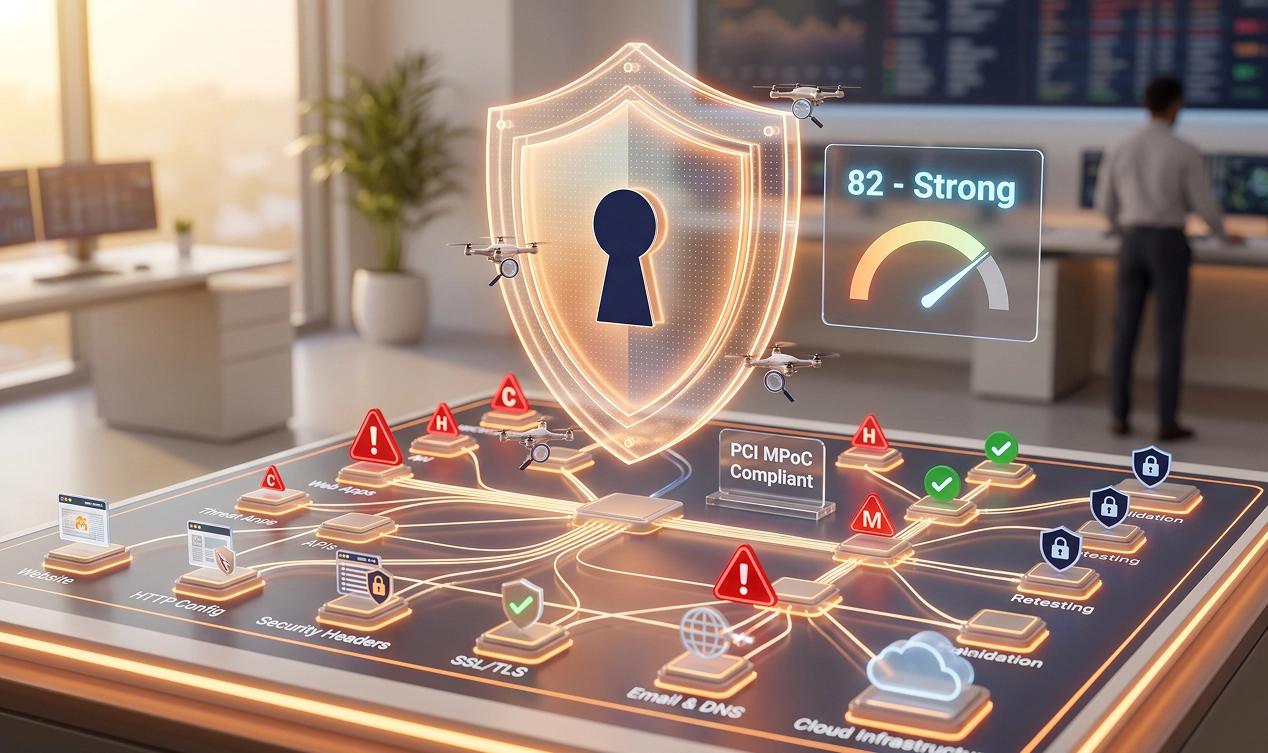
Vulnerability Assessment & Penetration Testing Workflow Diagram
What Is the VAPT Process? Step by Step
What is VAPT testing in an actual business scenario? Here is what a VAPT tester does, step by step.
- Step 1: Scoping and planning - The scope of engagement will clearly tell exactly what will be tested and what is off-limits.
- Step 2: Reconnaissance - Testers act like a real attacker to probe the system and identify the weaknesses in the system.
- Step 3: Vulnerability scanning - A broad system scan is conducted with automated tools to identify weaknesses and generate a raw list of vulnerabilities.
- Step 4: Vulnerability Assessment and Prioritization - Step 3 gives you an exhaustive list of vulnerabilities, but it does not tell you which ones are most dangerous. So, the VAPT team will assess them and rank them based on severity of risk.
- Step 5: Exploitation (penetration testing) - Now human testers step in and exploit the top-priority vulnerabilities to verify if an outside attacker can exploit them to breach the systems.
- Step 6: Impact analysis - Now the VAPT team will determine the real business risks based on their technical findings.
- Step 7: Reporting - The report from the VAPT team outlines the testing process and results. It gives a roadmap for the technical teams and management to fix their security issues.
- Step 8: Retesting - Once the recommendations have been implemented, retesting is done to make sure that the VAPT team’s recommendations are working.
Automated vs Manual VAPT: Which Do You Need?
An automated VAPT uses scanning tools to check the system against a database of vulnerabilities. In the case of a manual VAPT, a skilled human tester uses his knowledge of business context and attacker logic that automated tools cannot replicate.
Most security systems need both automated and manual VAPT testing at different points of the process.
Automated VAPT is like your smoke detector. It runs continuously on its own and can catch the obvious stuff early. Manual VAPT is slower and more expensive, but it is like a thorough examination by a fire marshal that catches risks that an automated VAPT might completely miss.
For most organizations, automated vulnerability scans can be scheduled regularly - weekly, monthly, or continuously. Manual penetration testing can happen quarterly or annually or after major software changes.
Types of VAPT Testing
If you were to ask an expert what is VAPT testing, they most probably would not give you a one-word answer. Because VAPT testing is not a single test, it is a family of tests that assess the different parts of your environment.
- Network penetration testing: External testing to simulate an outsider attacker and internal testing that simulates an attacker who is already inside your network.
- Web application testing.
- API (Application Programming Interface) penetration testing.
- Mobile application testing for iOS and Android apps.
- Cloud security testing (AWS, Azure, and Google Cloud)
- Wireless network or Wi-Fi testing
- Social engineering testing (to identify employee vulnerability to risks of phishing emails, pretext phone calls, or physical tailgating attempts.)
- Physical security testing to review breach risks to actual workstations and facilities.
What Does a VAPT Report Include?
Going into the specifics of what is VAPT testing, a VAPT report should include information for two of your teams - your technical team (who need to fix things) and your leadership team (who need to understand the risks).
- Executive summary: A plain language overview for the leadership and auditing teams.
- Scope and methodology with details like what was tested, what was not, and what frameworks were followed during the VAPT testing.
- Risk-ranked findings: based on severity as critical, high, medium, low, and informational.
- Proof of exploitation showing how a detected vulnerability can be exploited in a real-world scenario.
- Actionable and specific steps to address the vulnerabilities, including retest results.
- Business impact analysis, like the risk of data loss, financial exposure, legal consequences, etc. of the existing gaps.
Benefits of VAPT Testing
Knowing the benefits of VAPT testing is as important as knowing what is VAPT testing.
- The automated security scans find a bunch of theoretical risks that often overwhelm the teams. VAPT testing finds real-world risks with consequence.
- The organizations that use DevSecOps practices, i.e., integrating security practices during every phase of the development lifecycle, reduce the average breach expenses by $227,000.
- Regular security testing is evidence of due diligence and explicitly required by regulatory compliance.
- Preventing security breaches builds your brand's credibility and protects customer trust.
- Helps to assess your team's incident response readiness in case of a security breach.
- VAPT testing gives you a risk-ranked list. So, you can allocate your financial resources on the basis of actual exploitability.
How Often Should You Perform VAPT?
Once you know what is VAPT testing, the very next question is how often you should do VAPT testing. The frequency of VAPT testing depends on what is the risk profile of your organization and what are the regulatory requirements.
Annual VAPT testing
This is the baseline frequency that you must comply with for most regulatory frameworks.
After any significant change
Any change in code or configurations creates new vulnerabilities. So, VAPT testing is a must after any application update or new system deployment.
High-risk environments
Certain industries like fintech platforms, SaaS companies, etc., handle highly sensitive customer data. So, their VAPT testing has to be done quarterly or more frequently.
In many cases, automated scans are run as frequently as daily or weekly, and deeper penetration testing is done at periodic intervals.
Top VAPT Testing Tools
There is not a single VAPT testing tool that can support all necessary VAPT testing processes. So, depending on the scope and the types of testing that you need, you have to use a combination of VAPT tools.
Reconnaissance
- Nmap: The go-to open-source VAPT testing tool for first-step reconnaissance.
Vulnerability Assessment
- Nessus: Most commonly used vulnerability scanner.
- Nikto: Web server scanner that checks for outdated software or dangerous files.
Web Application Testing
- Burp Suite
- OWASP ZAP (Zed Attack Proxy): A free and open-source alternative to Burp Suite.
Penetration Testing
- Metasploit: Widely used during penetration testing to demonstrate the real-world impact of vulnerabilities.
Network Analysis & Monitoring
- Wireshark: Network protocol analyzer used to detect data leaks and suspicious activity.
- Aircrack-ng: For assessing Wi-Fi network security.
How to Choose the Best VAPT Provider for You?
- Does your VAPT provider have certified and experienced testers with hands-on experience? Do the testers have relevant industry experience in your business sector?
- Can your VAPT provider give you the exact percentage of automated scanning vs. manual testing?
- Ask for a sample report. Check if it is clear and actionable.
- Does the VAPT provider’s methodology meet the standards for compliance alignment?
- Is there at least one free round of re-testing support to confirm that the fixes are actually working as they are supposed to?
- The pricing of a VAPT test commonly falls between $5,000 and $30,000 depending on the scope. If the VAPT provider's quote is far out of this range, then you will end up with cheap testing that is not thorough or expensive testing that is excessive.
How BrandSecOps Simplifies Vulnerability Assessment and Penetration Testing?
Today most businesses use some form of digital systems - websites, APIs, servers, and so on. But not all of them can afford to have a dedicated in-house security team to manage the risks to their systems. So, they have to rely on periodical testing, which creates an extended period of vulnerability.
BrandSecOps gives an automated-first approach for businesses where vulnerability assessment can be run frequently and deeper manual penetration testing can step in without delay if a vulnerability is detected.
BrandSecOps is an automated scanning tool that runs vulnerability assessments for web applications, APIs, external servers and network infrastructure, and Android mobile applications.
Instead of juggling separate scanning tools, BrandSecOps gives you a centralized platform to track and manage all your vulnerability scanning.
Its dashboard not just gives you a list of vulnerabilities but also prioritizes them so you know exactly what issue needs to be fixed first.
BrandSecOps goes beyond identifying the obvious breach points and maps out your real attack surface for more effective scanning.
Apart from vulnerability scanning, BrandSecOps also supports compliance-oriented checks - a valuable input for management and auditing teams.