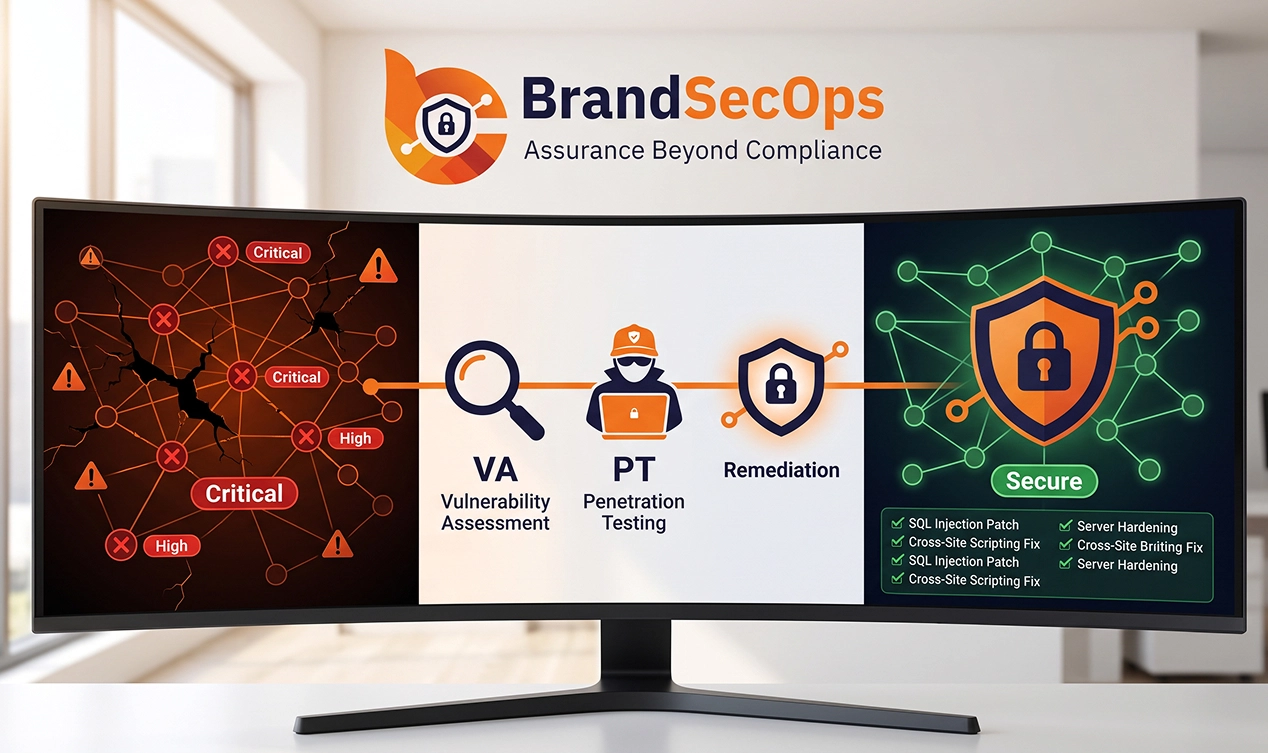
Vulnerability assessment vs penetration testing — two of the most commonly used terms when businesses discuss their cybersecurity. Sometimes they are used interchangeably, and sometimes they are perceived as substitutes for each other. But vulnerability assessment and penetration testing are not two names for the same thing. Nor can businesses use one to replace the other. And if you make the mistake of mixing them up, it can create serious security gaps in your organization's defenses.
According to Verizon’s 2025 Data Breach Investigations Report, exploitation of system vulnerabilities by third-parties accounted for 20% of data breaches. Other commonly used entry methods were misused credentials (22%) and phishing (16%). Exploiting software weaknesses is one of the most common vectors cybercriminals use to compromise enterprise networks.
A data breach does not just mean stolen funds. It also includes the financial burden of cleanup resources, system restoration, legal liabilities, and regulatory penalties. IBM’s 2025 Cost of a Data Breach Report found that the average global cost of a data breach has reached $4.44 million, while the average cost for organizations in the U.S. stands at a staggering $10.22 million!
A vast majority of these security incidents are preventable events if organizations understand vulnerability assessment vs penetration testing, knowing precisely what each process accomplishes and when to deploy which solution. Understanding the difference between vulnerability assessment and penetration testing is key because most modern digital enterprises genuinely require both to maintain robust security postures.
What Is a Vulnerability Assessment?
A vulnerability assessment is an automated, systemic review of your digital systems, networks, cloud infrastructure, and applications designed to identify and prioritize known security weaknesses. Rather than attempting to breach your infrastructure, a vulnerability assessment tool evaluates your environment against comprehensive security databases.
Automated scanning engines rely on public vulnerability repositories such as the National Vulnerability Database (NVD) and CVE catalogs. The assessment tool compares system software versions, active ports, service configurations, and cryptographic settings against known threat indicators to surface missing patches, outdated libraries, weak ciphers, or misconfigured access controls.
Furthermore, vulnerability scanning uses the Common Vulnerability Scoring System (CVSS) to assign standardized severity ratings ranging from 0.0 (Informational) to 10.0 (Critical). By prioritizing vulnerabilities based on CVSS metrics, the assessment delivers an actionable, risk-ranked inventory so your IT and DevOps teams know exactly which flaws to remediate first.
What Is Penetration Testing?
Penetration testing — often called a pen test — involves a certified security professional (or ethical hacker) executing simulated cyberattacks against your environment in the exact manner a real-world adversary would. Rather than stopping at identifying a potential flaw, penetration testing attempts to actively exploit system weaknesses to determine how deeply an attacker can compromise your network before being detected or contained.
A skilled penetration tester does not rely solely on automated tool outputs. The true value of a pen test lies in human creativity, critical thinking, and context-aware analysis. Ethical hackers chain together multiple low-severity findings, exploit subtle business logic flaws, attempt lateral movement across internal subnets, and execute privilege escalation techniques.
Automated security scanners cannot improvise, analyze complex multi-step logic, or think like a persistent threat actor. Therefore, automated tools can never fully replace human experts when conducting comprehensive penetration testing.
Vulnerability Assessment vs Penetration Testing: Key Differences
To clearly understand vulnerability assessment vs penetration testing, let us compare their core operational parameters across purpose, scope, speed, and execution methods.
| Factor | Vulnerability Assessment | Penetration Testing |
|---|---|---|
| Purpose | To identify and catalog known weaknesses across systems | To determine whether weaknesses can actually be exploited and how far an attacker could get |
| Method | Mostly automated scanning against known vulnerability databases | Manual, hands-on simulated attacks combined with custom tools |
| Depth | Broad but shallow — surface-level coverage across many assets | Narrow but deep — thorough exploration of a defined target scope |
| Speed | Fast — full scans can be completed within hours | Slower — thorough manual tests take 1 to several weeks |
| Frequency | Continuous or scheduled — weekly, monthly, or quarterly | Periodic — typically annually, or after major infrastructure changes |
| Cost | Lower cost per run; highly cost-effective for frequent execution | Higher cost per engagement due to specialized manual labor |
| Output | Prioritized list of vulnerabilities with CVSS severity scores | Detailed narrative report with exploited attack paths, business impact, and PoCs |
| Compliance | Satisfies quarterly scanning mandates (e.g., PCI DSS Requirement 11.3) | Satisfies annual penetration test mandates (e.g., PCI DSS Requirement 11.4, GDPR Art 32) |
| Performed By | Internal IT/DevOps staff or automated scanning platforms | Certified ethical hackers or specialized third-party security vendors |
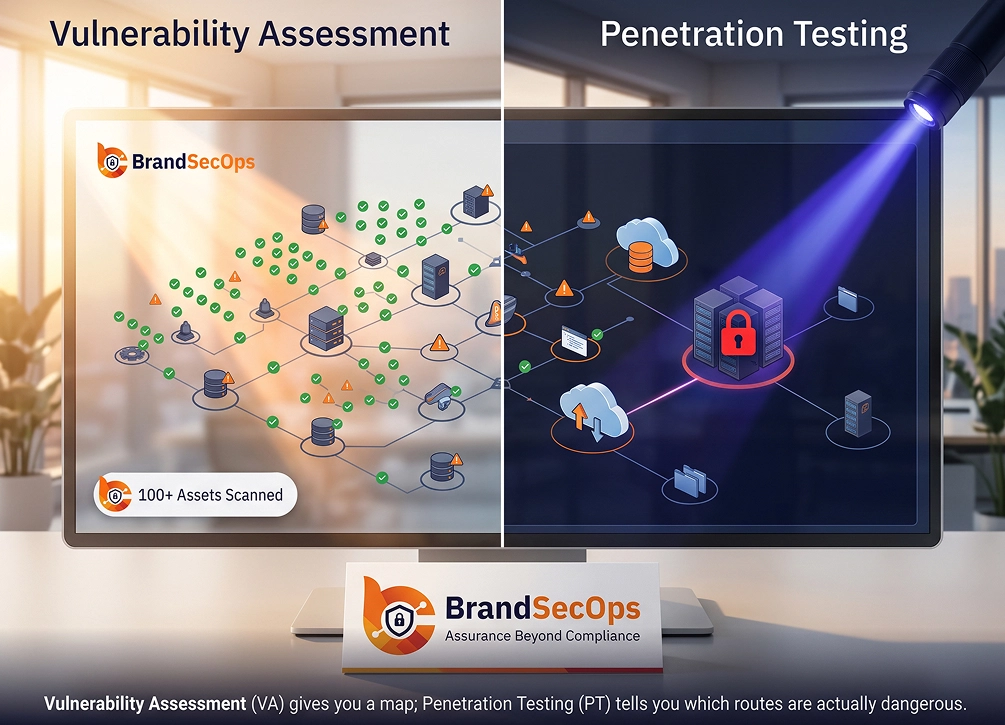
Vulnerability Assessment vs Penetration Testing Operational Matrix
The fundamental difference between vulnerability assessment and penetration testing: A vulnerability assessment tells you that a door is unlocked or your lock is faulty. Penetration testing tells you if an outside attacker can walk in through that door, steal your data, and how far they can get once inside.
Similarities Between Vulnerability Assessment and Penetration Testing
While there is a clear difference between vulnerability assessment and penetration testing, both methodologies share critical alignment when evaluating pen test vs vulnerability test parameters:
- Shared Security Goal: When conducting a pen test vs vulnerability test, both approaches share the ultimate objective of reducing security risk and protecting organization assets.
- Complementary Data Flow: Vulnerability assessment provides essential baseline telemetry and target data that enables penetration testing teams to pinpoint high-probability attack vectors quickly.
- Regulatory Mandates: Compliance frameworks such as PCI DSS, SOC 2, ISO 27001, and HIPAA explicitly require both vulnerability scanning and penetration testing for certification.
- Required Actionable Remediation: Neither process provides value if findings are ignored. Both require structured post-test remediation by engineering teams to fix identified flaws.
- Proactive Threat Defense: In any pen test vs vulnerability test evaluation, both security measures operate proactively to uncover vulnerabilities before external attackers can exploit them.
How the Vulnerability Assessment Process Works
The largely automated vulnerability assessment workflow is designed to execute quickly and repeatedly across enterprise networks. The process typically unfolds across five distinct stages:
- Asset Discovery and Scoping: Compiling an exhaustive inventory of all digital assets across internal and external environments, including web servers, cloud buckets, API endpoints, microservices, and network hardware.
- Automated Scanning: Running vulnerability scanners to query assets against updated CVE and NVD databases, evaluating software build versions, open ports, SSL/TLS configurations, and default credential usage.
- Analysis and Prioritization: Filtering out false positives and applying CVSS scoring metrics alongside business context to rank discovered vulnerabilities by severity.
- Comprehensive Reporting: Generating detailed technical documentation outlining vulnerability descriptions, CVSS risk scores, affected IP addresses, and specific remediation guidelines.
- Remediation and Re-scanning: Engineering teams patch software or reconfigure settings, followed by an immediate re-scan to verify that vulnerabilities have been remediated.
How the Penetration Testing Process Works
Penetration testing relies on structured testing frameworks such as NIST SP 800-115, OWASP Web Security Testing Guide (WSTG), and the Penetration Testing Execution Standard (PTES). The engagement progresses through seven key phases:
- Planning and Scoping: Defining rules of engagement, authorized testing windows, target IP ranges, application boundaries, and specific safety protocols with stakeholders.
- Reconnaissance and OSINT: Gathering intelligence about the target environment using public OSINT tools, DNS records, subdomains, employee metadata, and leaked credential databases.
- Vulnerability Identification: Combining automated tool outputs with manual inspection to identify high-potential exploitation entry points and logic flaws.
- Active Exploitation: Ethical hackers attempt to breach identified vulnerabilities, execute payload scripts, bypass authentication mechanisms, or chain minor flaws into severe exploits.
- Post-Exploitation and Impact Analysis: Demonstrating real-world business impact by simulating lateral movement, sensitive database access, or domain controller compromise without causing disruption.
- Reporting and Executive Debrief: Delivering a comprehensive report containing executive risk overviews, technical proof-of-concept (PoC) steps, and prioritized remediation recommendations.
- Retesting and Verification: Performing targeted follow-up testing after technical teams deploy fixes to confirm that exploited paths are closed.
When to Use a Vulnerability Assessment
For most organizations, initiating a vulnerability assessment is the logical first step in establishing security hygiene. Because scans are fast and cost-effective, they provide broad security coverage across rapidly evolving digital environments.
Key scenarios where vulnerability assessment is essential include:
- Rapid Infrastructure Visibility: When you need immediate oversight across expanding cloud environments (AWS, Azure, GCP), microservices, or new SaaS deployments.
- Continuous Security Monitoring: Running scheduled weekly or monthly scans to catch newly published CVEs and software misconfigurations before attackers discover them.
- Baseline Compliance Mandates: Satisfying internal and external scanning obligations required by PCI DSS Requirement 11.3, SOC 2 Type II, and ISO 27001 controls.
- Cost-Effective Entry Point for SMBs: Offering small and medium businesses an affordable way to audit system safety before investing in expensive manual pen testing.
When to Use Penetration Testing
Because penetration testing requires deep manual expertise, time, and financial investment, organizations strategically focus pen testing engagements on high-risk, mission-critical environments.
Key scenarios requiring dedicated penetration testing include:
- High-Value Target Validation: Testing critical financial platforms, payment processing gateways, healthcare portals, or core customer-facing applications.
- Validating High-Risk Scanner Findings: Determining whether high-severity vulnerabilities discovered during automated vulnerability assessments are truly exploitable in your specific operational context.
- Mandatory Annual Compliance: Meeting explicit requirements like PCI DSS Requirement 11.4, which mandates annual penetration testing or testing after any major infrastructure change.
- Major Technological or Corporate Changes: Validating network integrity following cloud migrations, codebase rewrites, core architecture updates, or corporate M&A integrations.
Can a Vulnerability Assessment Replace Penetration Testing?
Treating vulnerability assessment vs penetration testing as an either/or choice represents a dangerous misunderstanding of cybersecurity risk. When evaluating a pen test vs vulnerability test strategy, a vulnerability assessment cannot replace penetration testing, nor can penetration testing substitute for routine vulnerability scanning.
Automated vulnerability assessment tools can efficiently identify missing patches and software misconfigurations across thousands of assets, but they cannot evaluate complex business logic, chain minor vulnerabilities, or measure true exploitability. Conversely, manual penetration testing provides deep risk validation, but because pen tests are typically performed annually or bi-annually, relying solely on pen testing leaves your business vulnerable to newly disclosed threats during the long months between tests.
Understanding the difference between vulnerability assessment and penetration testing highlights that both services are designed to address distinct dimensions of risk. Attempting to replace one with the other introduces critical blind spots that threat actors can easily exploit.
Why Most Businesses Need Both
Modern enterprises do not view security through the narrow lens of vulnerability assessment vs penetration testing competition. When security officers weigh the trade-offs of a pen test vs vulnerability test, they realize that both tools fulfill essential roles.
Regulatory frameworks increasingly treat scanning and pen testing as distinct compliance obligations. Skipping either practice creates severe operational exposure:
- Scanning-Only Blind Spots: Relying exclusively on vulnerability scanning leads to security teams spending hundreds of hours patching theoretical vulnerabilities without understanding real-world attack exposure.
- Pen Testing-Only Blind Spots: Relying exclusively on periodic pen testing leaves systems unmonitored between tests, allowing newly released zero-days or minor misconfigurations to persist unaddressed for months.
How BrandSecOps Combines Vulnerability Assessment and Penetration Testing
BrandSecOps solves the dilemma of vulnerability assessment vs penetration testing by unifying both practices into a continuous, automated-first security workflow. Rather than treating pen test vs vulnerability test engagements as separate line items, BrandSecOps seamlessly bridges continuous scanning with expert manual testing.
- Continuous Automated Scanning: BrandSecOps enables on-demand and automated vulnerability assessments across web applications, APIs, cloud environments, and mobile platforms, immediately surfacing and ranking newly discovered vulnerabilities.
- Expert-Led Manual Penetration Testing: Certified ethical hackers analyze flagged vulnerabilities to test real-world exploitability, probing complex logic flaws and custom architecture that automated scanners miss.
- Unified Actionable Dashboards: Consolidates automated scan findings and manual pen test reports into a single, prioritized remediation roadmap for engineering teams.
- Automated Compliance Mapping: Maps technical vulnerabilities directly to regulatory standards like PCI DSS, SOC 2, ISO 27001, and GDPR for effortless audit compliance.
- One-Click Retesting: Allows teams to initiate instant reselling and targeted retests to confirm that security fixes are effectively deployed.
By combining continuous vulnerability assessment and periodic penetration testing into one platform, BrandSecOps delivers complete attack surface visibility alongside real-world risk verification.